Comprehensive Guide to Fire Extinguisher Classes & Types
Every home, office, and job site needs the right tool to stop a fire before it spreads. Fire extinguisher classes and types are not one-size-fits-all, and picking the wrong one can make a fire worse instead of putting it out. This guide breaks down fire classification, fire class ratings, and classes of fire so you know exactly which extinguisher matches which hazard. We will walk through every class, every type, and every rating so you can protect your space with confidence.
Key Takeaways
Fire extinguisher classes and fire extinguisher types depend on what is burning, not just the size of the flame. Selecting the correct unit, learning the PASS technique, and keeping up with maintenance are the three pillars of fire safety. Compliance with local codes keeps your property and people protected. This guide works as a resource you can use for Fire Extinguisher classes online research, whether you're stocking a kitchen, a garage, or a warehouse. Fire suppression and fire prevention start with readiness and preparation, not luck.
What Are Fire Extinguisher Classes?
Fire classification sorts fires by what fuels them, not by how big they are. Each fire class ratings system tells you which extinguisher will actually work. Fires are categorized and labeled using letters so responders and everyday users can act fast. In the United States, fire extinguisher classes ABCD cover most common hazards, with Class K added for kitchens. Class A fire involves solid materials. Class B fire involves liquids. Class C fire involves electricity. Class D fire involves metals. Class K fire involves cooking oils. Some regions also use Class F fire and Class E fire labels for similar hazards. Knowing your fire's class is step one in choosing the right tool.
The Fire Triangle and How Extinguishers Work
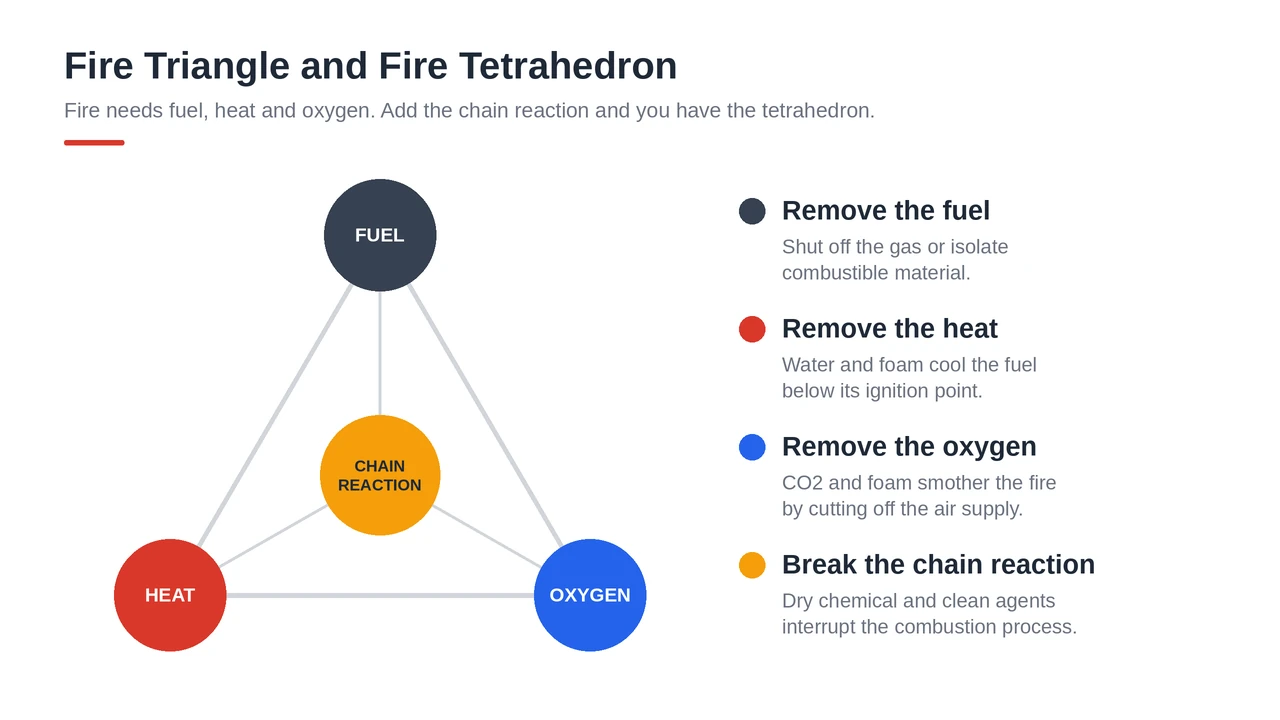
Every fire needs three things to burn: fuel, heat, and oxygen. This is called the fire triangle. Add a fourth element, the chemical chain reaction, and you get the fire tetrahedron. Fire extinguishers work by removing one of these pieces. An extinguishing agent might cool the heat, smother the oxygen, or starve the fuel supply. Some agents work by interrupting the chain reaction itself, stopping combustion at the molecular level. This is why fire suppression tools vary so much. A water stream cools flames. A foam blanket smothers them. A dry chemical interrupts the reaction. Understanding this cooling effect and smothering action explains why fire knockdown happens quickly with the right agent, and why flame suppression fails when the wrong one is used. The ignition source matters too, since removing it prevents re-ignition after the main fire dies down.
Fire Classes vs. Extinguisher Types
Classes of fire describe the fuel. Types of fire extinguishers describe the tool. This distinction confuses a lot of buyers, but it matters. Fire classification tells you what's burning: wood, gasoline, electrical wiring, or grease. The extinguishing agent inside the canister tells you how the fire gets put out. A single extinguisher type, like ABC dry chemical, can be rated for multiple classes at once. That's why labels use both classification symbols and agent names together. Comparing the two side by side helps you avoid grabbing a unit that's labeled correctly but built with the wrong agent for your specific risk.
The Different Fire Extinguisher Classes
The main fire class ratings you'll encounter are Class A fire, Class B fire, Class C fire, Class D fire, and Class K fire. Some international standards also list Class F fire and Class E fire. Each class targets a distinct fuel source, from paper to propane to power lines. Let's break down each one below, along with the agents built to fight them.
Class A Fire Extinguishers for Ordinary Combustible Fires
Class A fires start with ordinary combustibles. Think wood, paper, cloth, cardboard, rubber, plastics, and trash. These are the everyday materials found in homes and offices, and fabric-based items burn slowly but steadily once lit. Class A extinguishers are the most common type sold because these fuels are everywhere. Best Extinguishing Agents: A water extinguisher works well here, whether it's pressurized water, stored pressure water, water mist, or deionized water. Foam extinguishers using AFFF or FFFP also cool and smother these fires. ABC dry chemical units with monoammonium phosphate offer broader coverage for mixed hazards.
Class B Fire Extinguishers for Flammable Liquid Fires
Fire extinguisher Class B covers flammable liquids and combustible liquids like gasoline, oil, grease, paint, solvents, and kerosene. It also covers flammable gases such as propane, butane, and natural gas. These fuels and chemicals ignite fast and spread across surfaces, so smothering the oxygen supply is key rather than using water. Best Extinguishing Agents: Foam extinguishers, including AR-AFFF, film-forming foam, and aqueous film forming foam, create a blanket over the liquid. Fluorine-free foam and PFAS-free foam options are growing more common for environmental reasons. Dry chemical extinguishers using BC dry chemical, sodium bicarbonate, or potassium bicarbonate also work, along with CO2 extinguishers for smaller spills.
Class C Fire Extinguishers for Electrical Fires
Fire extinguisher Class C targets energized electrical equipment and live electrical fires. This includes appliances, wiring, circuit breakers, fuse boxes, electronics, and power tools. Panels, circuit breaker boxes, data centers, and server rooms all fall under this risk category. Household wiring fires can spread fast, and using the wrong agent risks electrocution or severe power outages. Non-conductive agents are essential here. Best Extinguishing Agents: CO2 extinguishers release carbon dioxide, or CO₂, to smother flames without leaving conductive residue. Dry chemical extinguishers, particularly ABC dry chemical, also work safely. Halotron and other clean agent extinguishers are popular for sensitive electronics because they are non-conductive and residue-free.
Class D Fire Extinguishers for Combustible Metal Fires
Combustible metals like magnesium, titanium, sodium, potassium, lithium, aluminum, and zirconium create metal fires that react violently with water. Lithium-ion battery fires fall into this dangerous group too. These fires reach extreme temperatures and are common in laboratories, manufacturing plants, and workshops where cutting, grinding, and casting take place. Best Extinguishing Agents: Dry powder extinguishers, such as Met-L-X, Na-X, and G-1 graphite powder, smother these fires safely. Copper powder and sodium chloride powder are also used. AVD extinguishers, built on aqueous vermiculite dispersion, are increasingly used for lithium battery extinguisher needs.
Class K Fire Extinguishers for Cooking Oil and Grease Fires
A Class K fire extinguisher is built for cooking oils, animal fats, and vegetable oils. These fires often start at a deep fat fryer or stove in commercial kitchen fires and restaurant settings. Grease fires burn hot and can reignite if not fully cooled, which is why range hoods and nearby extinguishers matter so much. Best Extinguishing Agents: Wet chemical extinguishers using potassium acetate or potassium citrate work through saponification, turning hot oil into a soapy, non-flammable foam layer.
Types of Fire Extinguishers by Extinguishing Agent
Beyond class ratings, types of fire extinguishers differ by the extinguishing agent inside. Agent type and agent properties determine how each unit performs. Some are cartridge-operated extinguishers, while others are stored-pressure extinguisher models. If you're wondering what are the 4 types of fire extinguishers most people ask about, they are water, foam, dry chemical, and CO2. Below, we cover each agent type in detail.
Water Fire Extinguishers
A water extinguisher uses pressurized water or stored pressure water to cool flames fast. Some models use water mist or deionized water for added safety around electronics. These units deliver a strong cooling effect and are built specifically for Class A fires.
Foam Fire Extinguishers
Foam extinguishers use AFFF, AR-AFFF, or FFFP to create film-forming foam that blankets liquid fuel. Aqueous film forming foam spreads across the surface, cutting off oxygen. Newer PFAS-free foam and fluorine-free foam options offer the same blanketing and smothering power with less environmental impact.
Dry Chemical Fire Extinguishers
Dry chemical extinguishers come in ABC dry chemical and BC dry chemical versions. As a multipurpose extinguisher, the ABC type uses monoammonium phosphate. BC versions use sodium bicarbonate or potassium bicarbonate. Purple-K and Super-K formulas rely on potassium bicarbonate and potassium chloride for fast knockdown by interrupting the chain reaction.
CO2 Fire Extinguishers
A carbon dioxide extinguisher, or CO2 extinguisher, works through oxygen displacement and smothering. CO₂ is non-conductive, making it ideal for electrical panels. Watch for cold burn risk and thermal shock when handling the horn. Use in ventilated areas to avoid asphyxiation from toxic fumes, though the agent itself leaves no residue.
Wet Chemical Fire Extinguishers
Wet chemical extinguishers use potassium acetate and potassium citrate. Through saponification, the agent cools grease while forming a soapy layer that blocks reignition. This is the standard choice for Class K fires in kitchens.
Dry Powder Fire Extinguishers
Dry powder extinguishers differ from dry chemical types. Products like Met-L-X, Na-X, G-1 graphite powder, copper powder, and sodium chloride powder work by smothering and forming a protective barrier or crust over burning metal. These are built specifically for Class D fires.
Clean Agent Fire Extinguishers
Clean agent extinguishers use halogenated agents like Halotron, Halon 1211, Halon 1301, HFC-236fa, FE-36, and FM-200. Novec 1230 is another common option. These agents are non-conductive but can release toxic fumes in enclosed spaces. They're popular for data center fire extinguisher, server room fire extinguisher, and museum fire extinguisher use, where residue would damage sensitive equipment.
Multi-Class Rating Extinguishers
A multi-class rating extinguisher covers more than one fire type in a single canister. These multi-purpose, versatile units simplify buying decisions for mixed-risk spaces.
ABC Fire Extinguishers
ABC fire extinguishers use ABC dry chemical to act as a true multipurpose extinguisher. They're the top pick for homes, businesses, and offices because they handle three fire classes at once.
BC Fire Extinguishers
BC fire extinguishers use BC dry chemical, built on sodium bicarbonate or potassium bicarbonate. These suit commercial kitchens and industrial settings where liquid and electrical risks overlap but solid combustibles are less common.
AB and Other Combination Ratings
Less common AB combination ratings and other combination ratings exist too. Some foam extinguisher models are water-based and cover both A and B fires without the dry chemical mess.
Fire Extinguisher Classes and Types Chart
A fire extinguisher chart makes comparison simple. Below is a basic fire extinguisher classes chart showing agent capacity, coverage, and suitability at a glance.
| Class | Fuel Type | Best Agent |
|---|---|---|
| A | Wood, paper, cloth | Water, foam, ABC dry chemical |
| B | Liquids, gases | Foam, CO2, dry chemical |
| C | Electrical | CO2, clean agent, dry chemical |
| D | Metals | Dry powder |
| K | Cooking oil | Wet chemical |
Which Extinguisher Type Works on Which Fire Class
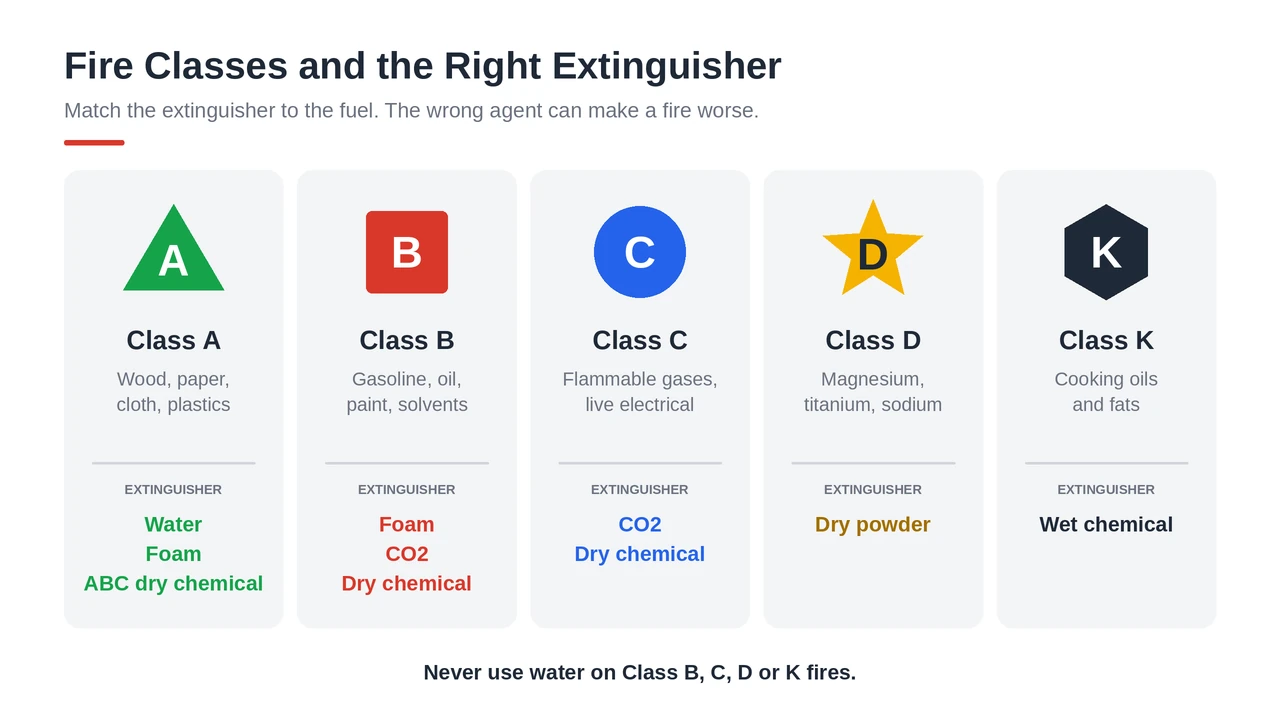
Knowing which fire extinguisher to use saves critical seconds. Suitability depends on matching the agent to the fuel, and full Class A/B/C/D/K coverage usually requires more than one unit type on site.
Extinguishers That Should Not Be Used on Specific Fire Classes
Using the wrong extinguisher can turn a small fire into a disaster. Do not use water on grease fires, since it causes splattering and spread. Do not use water on electrical fires, due to electrical conductivity risks. Do not use water on metal fires, because it can trigger violent reactions. Dry chemical agents also leave corrosive residue that requires cleanup, and using the wrong agent raises the chance of re-ignition.
Understanding Fire Extinguisher Ratings, Labels, and Color Codes
Fire extinguisher labels carry more information than most people realize. Learning fire extinguisher identification and rating systems helps you choose faster in an emergency.
Numerical Ratings
Every extinguisher carries a numerical rating like 1-A:10-B\:C, 2-A:10-B\:C, 3-A:40-B\:C, or 4-A:60-B\:C. Some units show 10-B\:C or 40-B\:C alone. These numbers reflect testing under UL 711 standards, with UL rating and ULC rating marks confirming performance.
Classification Symbols and Pictograms
Fire extinguisher symbols and fire extinguisher pictograms use simple pictures and letters so anyone can read them fast, even without training. These classification symbols replaced older color-only systems in many countries for clearer identification.
Color Codes and Identification Standards
Fire extinguisher color codes still matter in many regions. Red bodies are standard in the US, while a color band system using cream, blue, black, or yellow bands helps identify the agent type under British Standard color coding. European fire classes, American fire classes, UK fire classes, and Australian fire classes each use slightly different labeling, so check local standards.
Selecting the Right Fire Extinguisher
Learning how to choose a fire extinguisher doesn't have to be complicated. This buying guide breaks it into three simple steps, weighing pros and cons and limitations of each option to find the right extinguisher for the fire risks you actually face.
Step 1: Assess the Environment
Look at your environment and its specific risks and materials first. A home fire extinguisher differs from a kitchen fire extinguisher or garage fire extinguisher. Vehicles need a car fire extinguisher, vehicle fire extinguisher, RV fire extinguisher, boat fire extinguisher, or marine fire extinguisher, while planes need an aircraft fire extinguisher. Workplaces range from an office fire extinguisher to a warehouse fire extinguisher, restaurant fire extinguisher, laboratory fire extinguisher, hospital fire extinguisher, or school fire extinguisher. Workplace fire safety rules classify residential, commercial, and industrial spaces as light hazard, ordinary hazard, or extra hazard under occupancy hazard classification.
Step 2: Choose Based on Specific Risks
Match your extinguisher to the fuel sources on site. Class-A, Class-B, Class-C, Class-D, and Class-K rated units each target specific risks, so pick the one appropriate for what's actually around you.
Step 3: Consider Multi-Class Extinguishers
For mixed-use spaces, a multi-class ABC unit is often the most versatile choice, especially for businesses juggling several fire risks under one roof.
Extinguisher Size, Placement, and Accessibility
Agent capacity affects both extinguisher size and extinguisher weight. Common sizes include 2.5 lb, 5 lb, 10 lb, and 20 lb units, or 2 kg, 6 kg, and 9 kg models, with liquid agents measured at 6 liter or 9 liter. Each size affects discharge time, discharge range, and effective range. Codes typically require a travel distance of no more than 75 feet to the nearest unit. Proper extinguisher placement means mounting height at eye level on a wall bracket or inside a fire extinguisher cabinet, with clear fire extinguisher signage for visibility and accessibility. Options range from a portable fire extinguisher or handheld extinguisher to a wheeled extinguisher, fire extinguisher trolley, or wheeled unit for larger risks. These work alongside a fixed fire suppression system, fire blanket, sprinkler system, and smoke alarm for full coverage.
How to Use a Fire Extinguisher
Knowing how to operate a portable unit matters just as much as owning one, since panic during an emergency response slows reaction time.
The PASS Technique
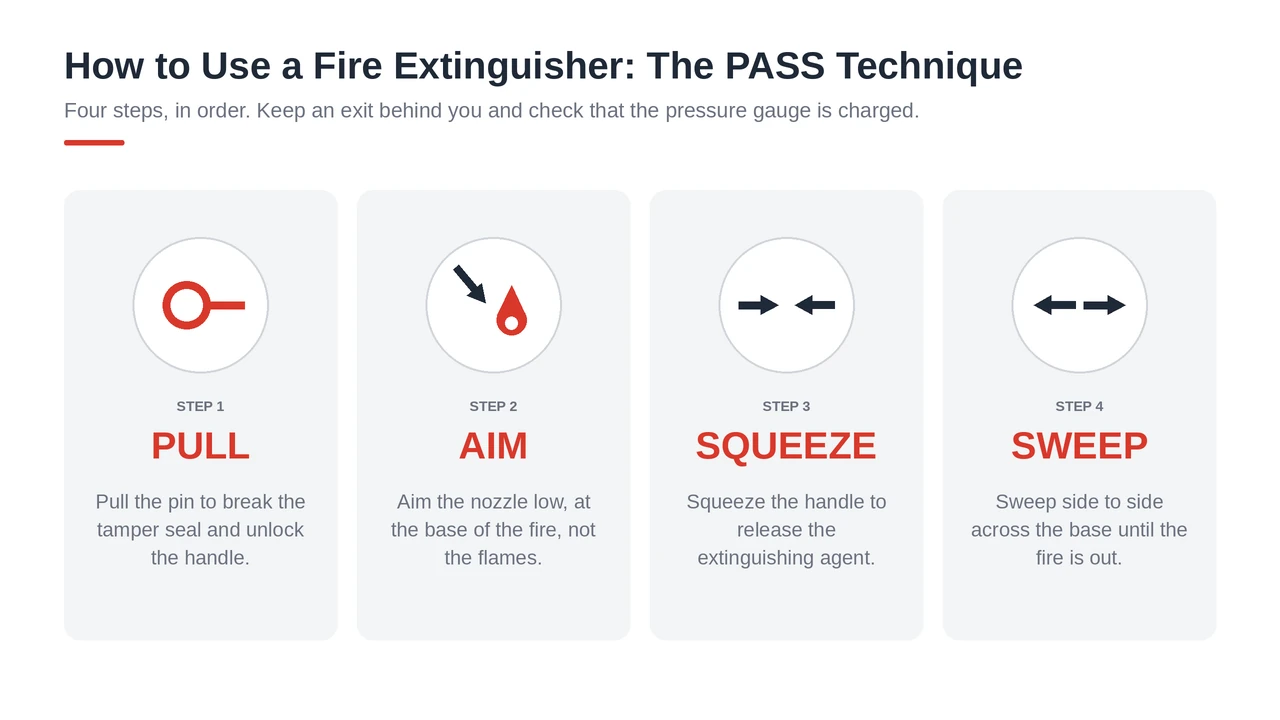
The PASS technique breaks down into four simple steps: Pull the pin past the tamper seal, Aim the hose or nozzle at the base of the fire, Squeeze the handle or lever, and Sweep side to side. Watch the pressure gauge and gauge needle to confirm you're in the green zone before starting. The cylinder, valve, and siphon tube push the agent out through the discharge horn. Keep a safe distance while discharging, and reassess as you go.
When to Fight a Fire and When to Evacuate
Only fight a small, incipient stage fire that hasn't spread. If the fire grows, becomes uncontrollable, or reignites after your first attempt, evacuate immediately. Safety is always the top priority over property.
Fire Extinguisher Inspection and Maintenance
Regular maintenance, inspection, and testing keep extinguishers ready when you need them most.
Regular Inspections and Servicing
A monthly inspection should check for visible damage or leaks through a quick visual inspection. An annual inspection requires professional servicing, with results logged on an inspection tag or service tag.
Recharging, Testing, and Replacement
Recharging keeps stored-pressure units full and ready. Hydrostatic testing follows a six-year maintenance schedule for internal checks, with a full twelve-year hydrostatic test for the cylinder itself. Track the expiration date and shelf life closely, and know whether your unit is rechargeable, disposable, or refillable before replacement or certification renewal.
Fire Extinguisher Requirements and Compliance Standards
In the US, NFPA 10 and NFPA 96 set the core rules for extinguisher placement and kitchen suppression, while OSHA 1910.157 and OSHA fire extinguisher requirements cover workplace compliance. Local fire code and the International Fire Code, or IFC, add further layers. Internationally, standards include BS EN 3, BS 5306, BS 7863, EN 2, ISO 7165, AS 1841, and AS/NZS 1850. Look for CE marking, FM Global approval, BSI Kitemark, or LPCB certification on quality units. A fire marshal, fire department, or fire inspector may require a documented fire risk assessment to confirm regulations and standards are met.
Training and Familiarity with Equipment
Employee training and a designated fire warden turn equipment into real protection. Running a fire drill regularly builds familiarity, so staff respond confidently instead of freezing up. A certified technician should handle inspections, while staff practice in a controlled environment. Trusted brands like Kidde, Amerex, Ansul, First Alert, Buckeye, Badger, Sentry, Firemaster, Chubb, and Britannia are common choices worth knowing by name.
Conclusion
Understanding fire extinguisher classes and types is the foundation of real fire safety. From fire prevention to fire suppression, every choice you make, from selecting the right agent to practicing the PASS technique, builds toward protecting lives and property. Readiness and preparation aren't optional extras. They're the best practices that make choosing the right extinguisher second nature when it counts most.
Frequently Asked Questions
What Are Class A, B, C, D, and K Fire Extinguishers Used For? Class A fire extinguishers handle ordinary combustibles. Class B fire covers flammable liquids. Class C fire targets electrical fires. Class D fire handles combustible metals. Class K fire is built for cooking oil fires. What Are the ABCs of Fire Extinguishers? ABC fire extinguishers use ABC dry chemical agent, making them a true multipurpose extinguisher for most common fire risks. Which Extinguisher Is Rated for Class A, B, and C Fires? An ABC fire extinguisher carries a numerical rating showing it's class-A, class-B, and class-C rated in one unit. What Is the Difference Between Class K and Class F Extinguishers? The difference between Class K and Class F mostly comes down to region. American fire classes use Class K, while European fire classes use Class F for the same cooking oil hazard. Can Water Be Used on Grease, Electrical, or Metal Fires? No. Do not use water on grease fires, electrical fires, or metal fires. Water raises electrical conductivity risk, causing electrocution, and can make metal fires react violently. What Is the Difference Between ABC and BC Extinguishers? The ABC vs BC extinguisher debate comes down to coverage. ABC fire extinguishers handle solids, liquids, and electrical fires, while BC fire extinguishers skip solid combustibles entirely.