The Five Classes of Fires and the Fire Extinguishers That Stop Them
Fire doesn't behave the same way twice. Wood burns slower than gasoline, and gasoline reacts differently than a live wire or a pan of hot oil. That's the whole point of fire classification — it sorts fire types into fire classes based on fuel, so you know exactly how to fight each one. This guide walks through the fire class system from Class A to Class K, matches each class to the right fire extinguisher, and shows you how to read labels so you never guess during an emergency. Understanding the five classes of fires and the fire extinguishers that stop them is one of the simplest ways to protect your home and workplace.
Key Takeaways
- Fires fall into five main groups: class A, class B, class C, class D, and class K.
- Every category needs a matching fire extinguisher; the wrong pick turns a small flame into a bigger problem.
- A quick-reference chart removes the guessing during a real fire.
- Knowing your categories ahead of time makes a fire extinguisher an actual lifesaver.
- Fire prevention and fire suppression only work when you're prepared with the proper tool.
- This guide covers types, importance, and how to identify and match extinguishers correctly.
What Are the Classes of Fire?
Fire classification is the system used for categorising fire by fuel and material. Instead of treating every flame the same, this classification system groups fires by the nature of burning, the combustion process, and the combustion products released. Identifying the correct class carries real importance, since each fire hazard needs different criteria for safe extinguishing. A recognized breakdown helps you spot fire risk before it grows into an emergency. Common causes range from organic material like wood to industrial chemicals, and this breakdown forms the foundation of solid fire-protection.
How Fires Are Classified by Fuel Type
Every fire needs a fuel source, and that fuel type decides its class. Class-A fires burn solid materials, or ordinary combustibles. Class-B fires involve flammable liquids. Class-C fires involve flammable gases and energized electrical equipment. Class-D fires ignite combustible metals. Class-K fires feed on cooking oils. Fuel can be solid, liquid, or gas, and each state changes fire behavior — a metal fire, for instance, burns hotter than one fueled by paper.
The Fire Triangle and Fire Tetrahedron
Every fire needs fuel, heat, and oxygen — the fire triangle. Add a fourth piece, the chemical chain reaction, and you get the fire tetrahedron. Combustion starts once an ignition source pushes fuel past its flash point, then its fire point, then its autoignition temperature. This exothermic reaction spreads through oxidation, while pyrolysis breaks solid fuel into flammable gas. Stopping fire means achieving chain reaction interruption. Flammability sits between a fuel's lower explosive limit (LEL) and upper explosive limit (UEL), and vapor density affects how gas spreads. Fires also release toxic fumes, including carbon monoxide from incomplete combustion, plus thermal energy and radiation.
The Fire Classes Chart at a Glance
A quick-reference fire classes chart helps you identify categories fast:
| Class | Fuel Type |
|---|---|
| Class-A | Wood, paper, ordinary solids |
| Class-B | Flammable liquids |
| Class-C | Electrical equipment |
| Class-D | Combustible metals |
| Class-E | Electrical (UK/AU term) |
| Class-F | Cooking oils (UK/AU term) |
| Class-K | Cooking oils/fats (US term) |
The Five Classes of Fire Explained
Class A fire, Class B fire, Class C fire, Class D fire, and Class K fire each show up in different settings, from home offices to busy kitchens. Knowing common examples helps predict fire behaviour, fire spread, and fire growth.
Class A Fires: Ordinary Combustibles
Class A fires burn ordinary combustibles — wood, paper, cloth, cardboard, rubber, and plastics. Textiles and fabric catch easily, and a pile of trash can ignite within minutes. These fires often start with glowing embers, then spread gradually as polymers and organic material feed sustained heat release. You'll find them in living rooms, schools, and offices wherever fabric sits near a heat source.
Class B Fires: Flammable and Combustible Liquids
Class B fires involve flammable liquids and combustible liquids: gasoline, oil, grease, paint, solvents, kerosene, and alcohol. Hydrocarbons, mineral spirits, alcohols, and oil-based paints release flammable vapors that ignite fast on a surface liquid, showing rapid development and intense heat almost instantly. Petrol spills in a garage, paint cans in a workshop, or solvent storage make common triggers.
Class C Fires: Flammable Gases and Energized Electrical Equipment
Class C fires cover flammable gases — propane, butane, methane, natural gas, acetylene, hydrogen — and energized electrical equipment. A live electrical fire starts in wiring, circuit breakers, appliances, or transformers running high voltage. Faulty power supply or poor installations raise shock risk. Gas that builds up in enclosed spaces can cause deflagration or explosion once ignited, so never use water here.
Class D Fires: Combustible Metals
Class D fires ignite combustible metals like magnesium, titanium, sodium, potassium, lithium, aluminum, and zirconium. These metals often burn as shavings or granules, common in labs, factories, and industrial settings. They react violently with water, so they need aggressive agents built specifically for metal combustion.
Class K Fires: Cooking Oils and Fats
Class K fires start with cooking oils and cooking fats, usually in a deep fat fryer. A commercial kitchen fire involving vegetable oil fire or animal fat fire burns hotter than a typical flare-up. Restaurants, cafeterias, and busy kitchens face this daily. Reignition potential is the real danger, since trapped heat-transfer inside oil can reignite flames minutes later.
Fire Extinguishers That Stop Each Class of Fire
Matching the right fire extinguisher to each fire class saves lives and property. Fire extinguisher types use different extinguishing agents and extinguishing methods, and most portable units act as a suppression agent for one or two classes.
Class A Fire Extinguishers
A water extinguisher using pressurized water works best here. Foam extinguisher and ABC extinguisher models also handle wood, paper, and cloth fires. Water delivers a strong cooling effect, dropping fuel temperature fast.
Class B Fire Extinguishers
Foam extinguisher and CO2 extinguisher units, plus a dry chemical extinguisher, handle Class B fires. AFFF foam works by smothering flammable liquids and creating vapor suppression at the surface, stopping reignition.
Class C Fire Extinguishers
CO2 extinguisher and dry chemical extinguisher models suit Class C fires because they stay non-conductive — safe for energized equipment like circuit breakers, power tools, outlets, server rooms, and offices.
Class D Fire Extinguishers
Class D fires need a dry powder extinguisher. Sodium chloride powder, graphite powder, and copper powder are specialized agents for magnesium, titanium, and sodium fires. These incidents are rare but serious.
Class K Fire Extinguishers
A wet chemical extinguisher uses potassium acetate, triggering saponification that forms a cooling soap layer and cuts re-ignition risk. Deep fryers, stovetops, ovens, commercial kitchens, restaurants, and food trucks all need one.
Multipurpose ABC Fire Extinguishers
An ABC extinguisher, or multipurpose extinguisher, uses ammonium phosphate or monoammonium phosphate. This multi-use dry chemical covers Class A, B, and C fires in one canister.
Fire Class and Extinguisher Matching Chart
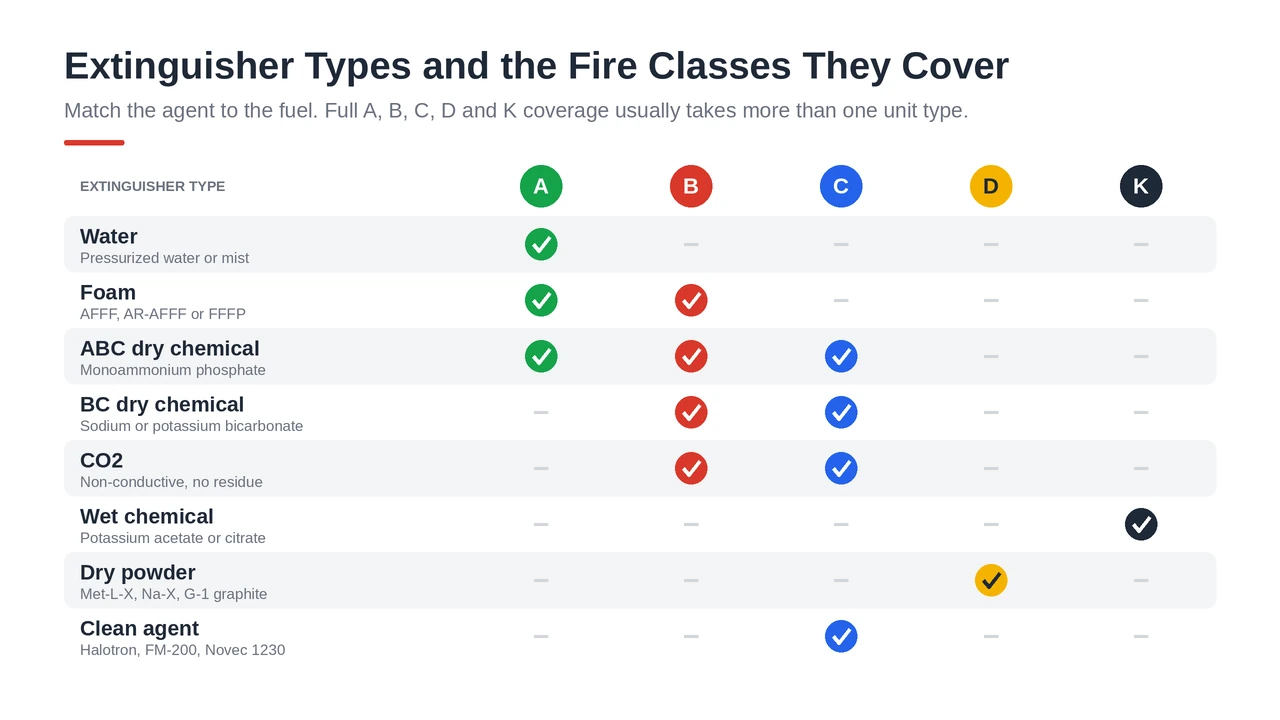
This matching chart removes type guessing for any business owner, facility manager, or homeowner:
| Fire Class | Recommended Extinguisher |
|---|---|
| Class A | Water, Foam, ABC |
| Class B | Foam, CO2, Dry Chemical |
| Class C | CO2, Dry Chemical |
| Class D | Dry Powder |
| Class K | Wet Chemical |
Post this chart near your building's extinguisher so everyone stays ready for the unexpected.
Fire Extinguisher Types and How They Work
Every fire extinguisher type stores an extinguishing agent under pressure, either stored-pressure or cartridge-operated, and releases it through a portable hose.
Water and Water Mist Extinguishers
A water extinguisher relies on pressurized water or fine water mist to cool burning fuel below its ignition point. Both are rated strictly for Class-A fires.
Foam Extinguishers
Foam extinguisher units use AFFF, or aqueous film forming foam, which spreads through film formation and blankets fuel. This blanketing cuts off oxygen. Rated for Class-A and Class-B fires.
Dry Chemical Extinguishers
A dry chemical extinguisher uses ammonium phosphate, sodium bicarbonate, potassium bicarbonate, or monoammonium phosphate. These interrupt the chain reaction and cover Class-B and Class-C fires.
CO2 Extinguishers
A CO2 extinguisher releases carbon dioxide (CO₂), displacing oxygen. Since it's non-conductive, it suits Class-B and Class-C fires around electronics and panels, with no residue left behind.
Wet Chemical Extinguishers
A wet chemical extinguisher uses potassium acetate to trigger saponification on cooking oils. This is the standard for Class-K fires in any kitchen.
Dry Powder Extinguishers
Don't confuse this with dry chemical. Dry powder extinguisher units use sodium chloride powder, graphite powder, or copper powder, built for Class-D metal fires.
Clean Agent Extinguishers
A clean agent extinguisher uses halon, halotron, FM-200, or halocarbon compounds. These halon alternatives protect electronics in a data center fire or server room fire without damaging sensitive equipment.
How to Read Fire Extinguisher Labels, Symbols, and Ratings
Every canister carries fire extinguisher labels, symbols, pictograms, color coding, and ratings that tell you exactly which classes it fights.
Class Letters, Pictograms, and Color Coding
Class symbols use shapes: a triangle symbol often marks Class A, square marks Class B, circle marks Class C, star marks Class D, and hexagon marks Class K. A lightning bolt symbol warns of electrical risk, while a flame symbol or cooking pot symbol points to fuel type. Color bands like a red extinguisher body with a blue label, green label, yellow label, or black label help you identify the right tool through simple icons.
Numerical Ratings (e.g., 2-A:10-B\:C)
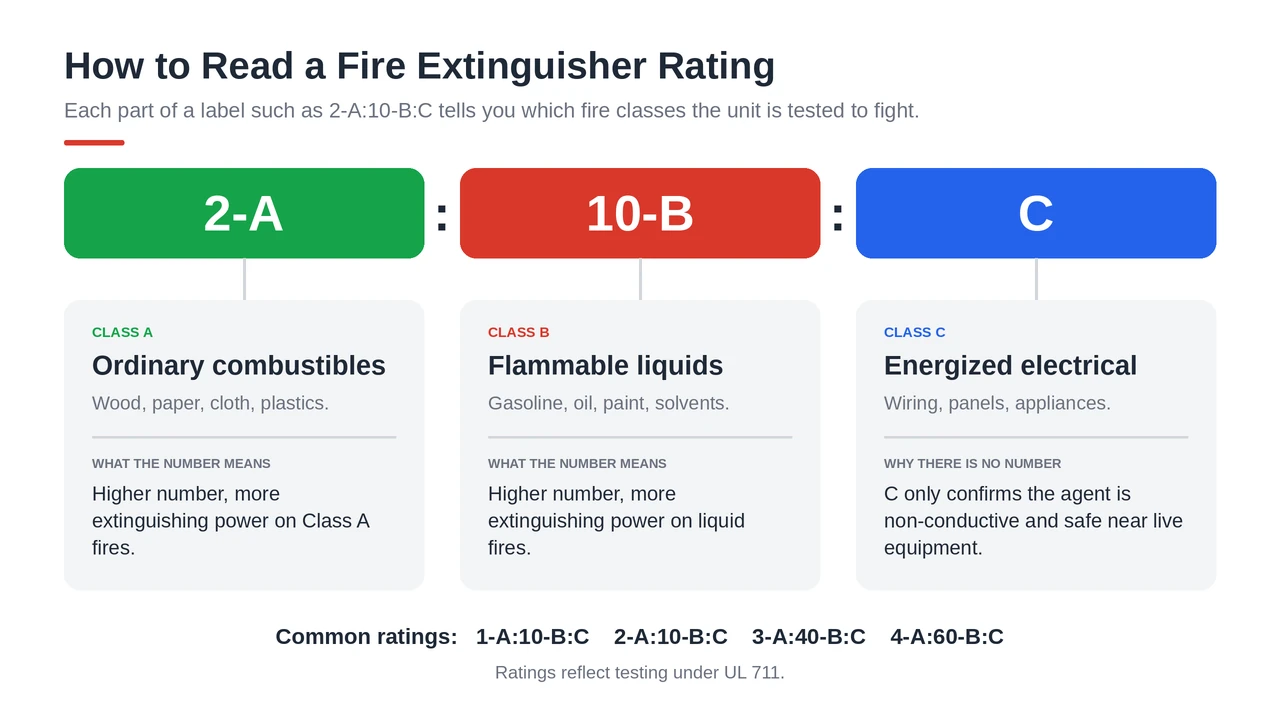
A numerical rating shows extinguishing power. A 1-A rating handles a small Class A fire, while 10-B covers a bigger liquid fire. Combined ratings like 40-BC or 2-A:10-B\:C show exact strength per class. This lettered classification lets you compare extinguisher rating and fire rating before buying.
What Happens When You Use the Wrong Extinguisher?
Grabbing the wrong extinguisher turns a small flame into a disaster. Extinguisher misuse with an incompatible extinguisher — like water on a grease fire — can cause a steam explosion or boil-over, throwing burning oil into the air. Water is water-reactive with certain metals, sparking a violent reaction instead of stopping flames. Using water on Class C fires raises electrocution risk, since water conductivity carries current back to you; always attempt power isolation and de-energize equipment first. Foam or CO2 on the wrong surface can cause flashback or splash hazard. Some agents leave corrosive residue, adding damage to equipment and costly cleanup. Skipping compatibility checks also leads to noncompliance. These mistakes turn an unsafe moment into real harm, injury, and escalation that proper matching prevents.
Fire Classification Around the World
International fire classification uses different naming systems across territories, though most follow a similar standard built around fuel type.
US Fire Classes (NFPA)
American fire classes follow NFPA, the National Fire Protection Association. US fire classes run A through K, shaping extinguisher design and building codes across the U.S.
European and UK Fire Classes (EN 2)
European fire classes and UK fire classes follow EN 2, the European standard, and BS EN 3, the British standard, running A through F.
Class F vs. Class K Fires
Class F fire and Class K fire both describe cooking oils and fats — animal fat and vegetable oil fires. The difference is naming: Class F in Europe and the UK, Class K in the U.S.
Class E Electrical Fires
Class E fire refers to energized electrical equipment under Australian fire classes, set by AS 1850. This class doesn't exist in the US system, where it falls under Class C.
The ISO Standard for Classes of Fire
The ISO standard offers a global reference for international fire classification, helping countries align their classes of fire despite different local names.
Classes of Fire Onboard Ships and Vessels
Marine vessels and ships face fire risk from solids like bedding and textiles, or lubricants stored in galleys. Crew training is critical, since a dangerous fire at sea allows for no quick escape. Onboard classifications mirror standard fire classes, but crews train for effective, safe response in tight spaces.
Why Matching the Extinguisher to the Fire Class Matters
Correct fire prevention and fire protection choices support life safety, property protection, and injury prevention for everyone in a building.
For Homes
Home fire safety starts with knowing your risks. Residential spaces face house fire dangers in the kitchen, garage, and living rooms. One correctly placed extinguisher can stop a small flame before it spreads.
For Businesses and Workplaces
Workplace fire safety covers wider hazards. Industrial fire safety and commercial fire safety deal with warehouse fire risk, laboratory fire hazards, and chemical plant dangers. Hospitals, schools, offices, and workshops each carry different occupancy risks — a data center fire, for example, demands clean agents, not water.
Fire Code and Compliance Requirements (NFPA 10, OSHA)
NFPA 10 sets standards for extinguisher selection, placement, and maintenance. NFPA 704 adds hazard labeling. OSHA enforces rules under 29 CFR 1910.157. Following these fire codes, regulations, and standards keeps you in compliance, satisfies insurance requirements, reduces liability, and supports certification.
How to Choose the Right Fire Extinguisher for Your Property
Choosing the right extinguisher takes more than grabbing the first red canister. Extinguisher selection and extinguisher identification depend on your specific risks and layout.
Assess Your Fire Risks and Hazards
Start with a fire risk assessment. A hazard assessment looks at your fire load — how much fuel sits in the space. Check for hazardous materials (hazmat) and review each safety data sheet (SDS) to spot fire hazard and fire risk before buying anything.
Where to Place Fire Extinguishers
Extinguisher placement depends on mounting height, accessibility, and travel distance. Add fire safety signage above each unit. Occupancy type, like a warehouse versus an office, changes how many units you need.
How to Use an Extinguisher (PASS Technique)
The PASS technique makes extinguisher operation simple: Pull the pin, Aim at the base, Squeeze the handle, Sweep side to side. Check the nozzle and pressure gauge to confirm the cylinder is charged before you rely on it.
Inspection, Maintenance, and Servicing
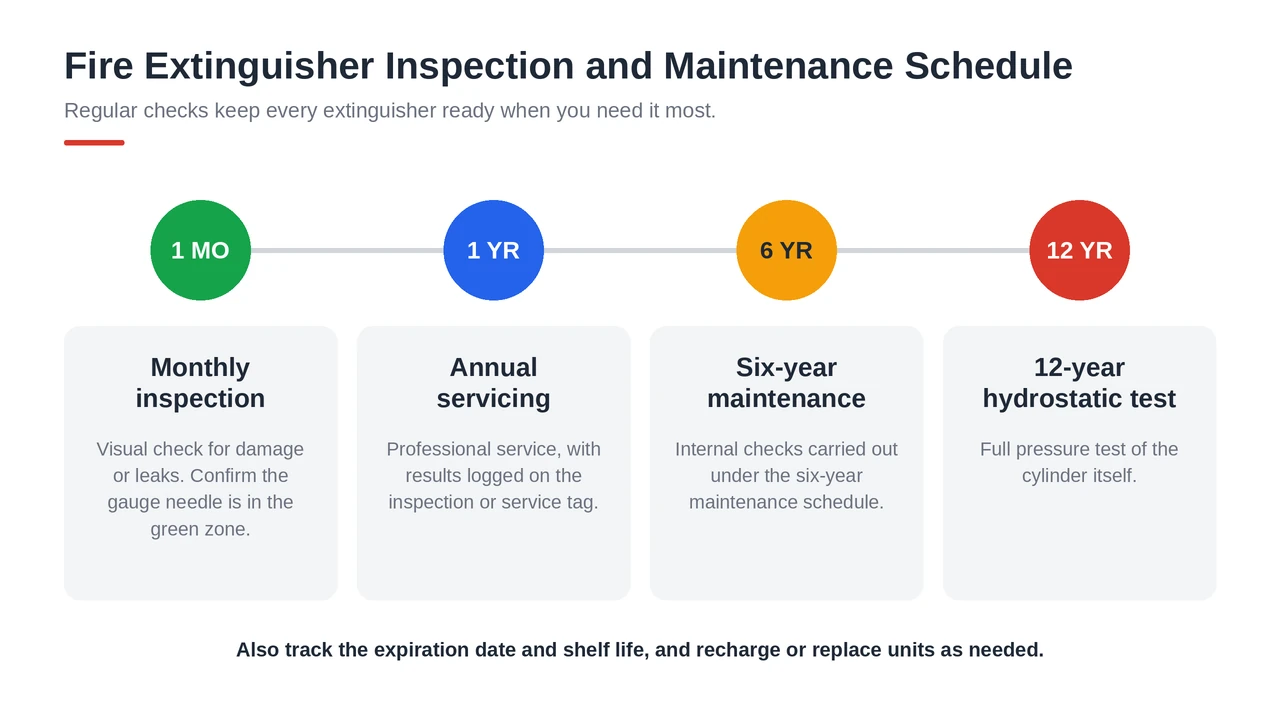
Extinguisher inspection should happen monthly, with professional extinguisher maintenance and servicing yearly. Testing confirms pressure holds, and units may need a recharge or refill after use. Extinguisher training keeps staff ready to respond.
When to Call a Fire Protection Professional
Some jobs need a fire protection professional. Contact your fire department, first responders, or emergency services for complex layouts. A fire brigade, fire marshal, fire safety officer, or fire warden can review your building and recommend upgrades.
Frequently Asked Questions
What Are the 5 Classes of Fires?
The 5 classes of fire, in order, are Class A, B, C, D, and K — answering what are the 5 different classes of fire by fuel type.
What Are Class A, Class B, Class C, and Class D Fires?
Class A burns solids like wood and paper. Class B burns liquids like gasoline. Class C involves energized wiring. Class D burns metals like magnesium and titanium.
What Is a Class A, Class B, Class C, and Class D Fire Extinguisher?
These extinguisher types match their class: class-A uses water or foam, class-B uses foam or CO2, class-C uses CO2 or dry chemical, class-D uses dry powder.
What Is a Class D Fire Extinguisher Used For?
It stops metal fires involving combustible metals like magnesium, titanium, and sodium, common in labs and factories.
What Is a Class K Fire Extinguisher Used For?
It stops Class K fires and cooking oil fires in kitchens using wet chemical agents that cool oil and prevent reignition.
What Is the ISO Standard for Classes of Fire?
The ISO standard sets a shared global reference for classifying fire, helping countries align terms despite different local labels.
What Are the Classes of Fire Onboard?
Classes of fire onboard ships follow standard categories, but crews train specifically for solids, lubricants, and electrical fires in tight spaces at sea.
Conclusion
Fire safety comes down to knowing your enemy. The five classes of fires and the fire extinguishers that stop them give you a clear framework for fire prevention, fire protection, and fast response. Matching the right tool supports property protection and life safety for everyone nearby. Staying prepared means acting as your own partner in safety, using knowledge instead of guesswork. Fire fatalities and fire statistics show most fire incidents trace back to a few common fire causes, all preventable through fire education and fire awareness. Keep these fire safety tips, follow best practices, run a safety checklist, and maintain workplace compliance so lives and property stay protected.